What is GEO and why your content strategy needs to account for it

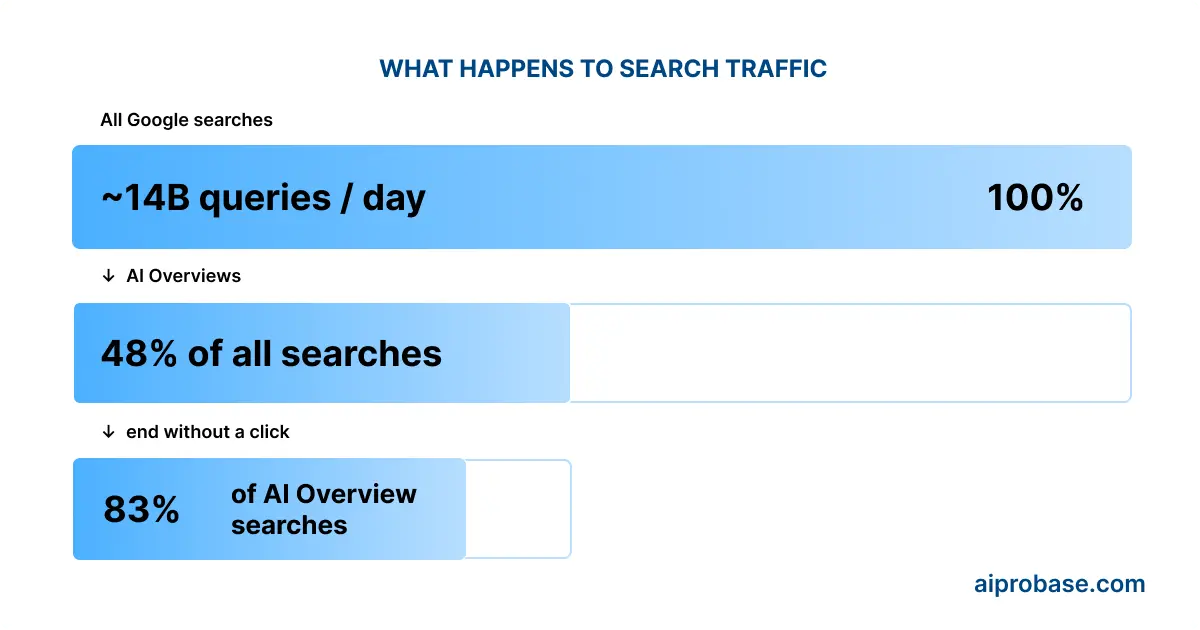
In 2026, nearly two thirds of all Google searches end without a click on any result. On queries where Google's AI Overviews appear, that figure reaches 83%.
Users get answers directly in ChatGPT, Perplexity, Google Gemini, and Claude. Your content can rank first in search results and receive zero traffic, because the AI gave the answer before anyone clicked.
This isn't a forecast. It's already the baseline.
GEO — Generative Engine Optimization — is the practice of structuring content so that AI systems use it when generating answers.
Traditional SEO gets your page in front of users. GEO gets your content into the answer itself. The mechanisms are different, and in some cases they work against each other. If you're wondering whether this means SEO is no longer relevant, the answer is more nuanced than that.
The scale of what's changed: ChatGPT was handling 2.5 billion prompts a day by mid-2025 (OpenAI, via Axios) and reached 900 million weekly users by February 2026 (OpenAI). Perplexity processed 780 million queries in May 2025, per CEO Aravind Srinivas at Bloomberg's Tech Summit. Google AI Overviews now appear on 48% of all searches globally, up 58% year-over-year. When these systems generate an answer, a small fraction of users click through to the source. Most don't.
Bain & Company research from early 2025 found that 80% of consumers rely on zero-click results in at least 40% of their searches, with an estimated 15–25% reduction in organic web traffic as a result. The trend is consistent across markets: U.S. zero-click stood at 60.45% in 2024 and 68% by early 2026 (SparkToro/Similarweb).
The old goal — ranking in the top 10 — is still useful. But it's no longer sufficient. The new goal is becoming the source an AI cites.
In 2023, researchers at Princeton and IIT Delhi published "GEO: Generative Engine Optimization" — a study testing specific content optimization methods at scale. The paper was accepted at KDD 2024. It's one of the few empirical studies on this topic with real methodology rather than speculation.
The researchers built a benchmark across 10,000 queries using Perplexity.ai, testing different optimization approaches across factual, opinion-based, comparative, and instructional query types.
What worked, and by how much:
The strongest methods — adding quotations, statistics, and source citations — boosted visibility by up to 40% on the study's benchmark, with the best single result at 41% on the primary metric. Validated on Perplexity.ai, a live generative engine, the same methods improved visibility by up to 37%.
Quotation addition — embedding authoritative quotes with attribution — was the most consistently effective method. Statistics addition showed the highest ceiling.
Before: "Swiss people love chocolate."
After: "With per capita annual consumption averaging between 11 and 12 kilos, Swiss people rank among the top chocolate lovers in the world (International Chocolate Consumption Research Group)."
The second version significantly increased the content's visibility in AI-generated answers. Same claim. Different shape.
Cite sources (linking to verifiable external sources within the content) improved visibility by 27%, particularly for factual queries. Fluency optimisation — clearer writing, shorter sentences, less filler — improved performance across all metrics.
The most useful finding: combining methods compounds the result. Fluency plus statistics outperformed any single method by 5.5%.
The study produced one finding that cuts against conventional assumptions: sites with low search rankings gained the most from GEO optimisation.
In the study's competitive simulation — where every site applies GEO methods — a site in fifth position increased its AI visibility by 115%, while top-ranked sites lost 30% of theirs. These numbers describe how visibility share redistributes when everyone optimises, not a guaranteed lift for any single site. But the direction is the point: the playing field tilts toward content quality, not incumbency.
The explanation is structural. Domain authority still matters at the retrieval step — it influences whether your page enters the pool of candidate sources at all. But once retrieved, generative engines evaluate content directly: its structure, specificity, and verifiability. That second step is where rankings stop protecting incumbents. A small business with well-structured, factual, cited content can outperform a large competitor with more SEO resources if the content itself is more useful to the model generating an answer.
For the first time in twenty years, a search-adjacent channel doesn't automatically reward whoever got there first.
GEO-optimised content has a different shape from traditional SEO content.
It makes specific claims with attributed sources rather than general statements. It answers questions directly before elaborating. It includes verifiable numbers rather than approximations.
None of this makes the content worse for human readers. In most cases it makes it better — clearer, more credible, easier to scan. GEO and readability are aligned, not in tension.
The KDD study tested prose-level methods — what you write and how. Structured data operates at a different layer, one the study didn't measure: JSON-LD, FAQPage schema, and HowTo markup are parsed by machines directly, independently of the prose. A page without structured data is readable by AI. A page with structured data is understandable — the difference between a model having to infer what your business does versus being told explicitly. This is the core principle behind what Aiprobase does: converting your business information into every format AI systems use.
The four methods from the KDD 2024 research translate into concrete content decisions:
Add specific numbers to factual claims, with sources. Replace "many users" with documented figures. Replace "significant growth" with a percentage and a citation.
Embed authoritative quotes where you're making claims that depend on external authority. Don't paraphrase — quote directly and attribute.
Link to verifiable sources within the text, not just in a references section. In-text citations to verifiable sources are the pattern the research actually tested — a references block alone wasn't.
Improve readability systematically: shorter sentences, one idea per paragraph, no filler phrases. This improves performance across all GEO metrics simultaneously.
Stack the methods. The compound effect is real and documented.
arXiv / KDD 2024:
GEO: Generative Engine Optimization
SparkToro & Similarweb (June 2026):
In 2026, Less than One Third of Google Searches Still Send a Click
BrightEdge (February 2026):
AI Overviews at the One-Year Mark: Presence, Size, and What They're Citing
Bain & Company (February 2025):
Goodbye Clicks, Hello AI: Zero-Click Search Redefines Marketing
TechCrunch (July 2025):
ChatGPT users send 2.5 billion prompts a day
TechCrunch (June 2025):
Perplexity received 780 million queries last month, CEO says