SEO is not dead. But it's not enough anymore.

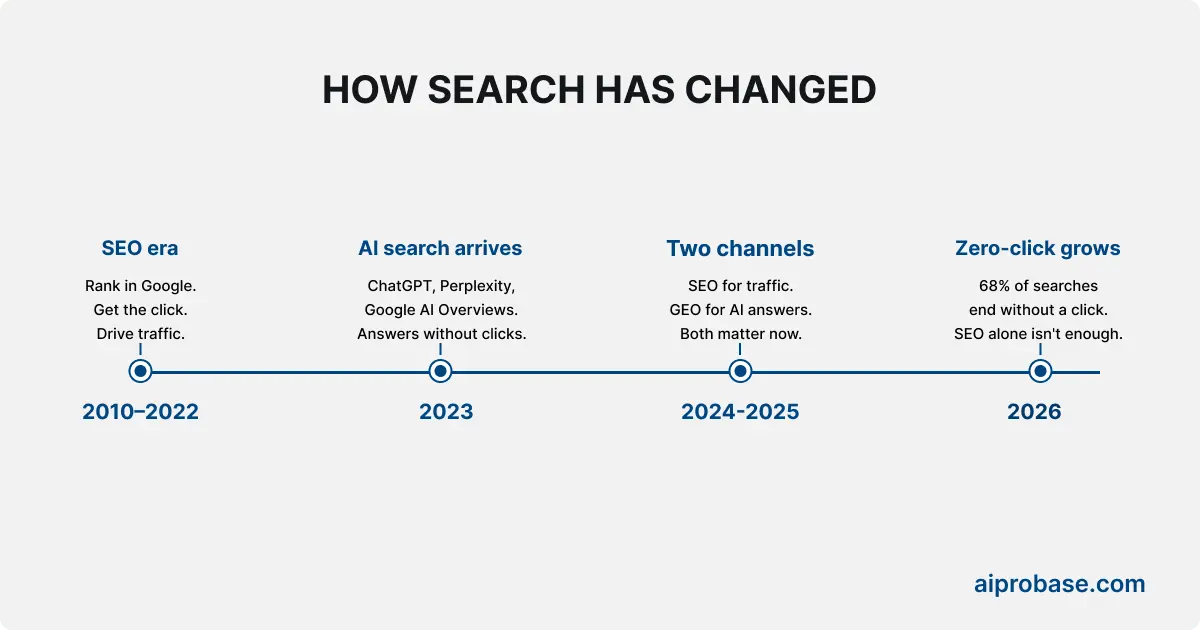
People keep declaring SEO dead. It's not. But the argument behind the declaration is real, and worth taking seriously.
Google handles over 5 trillion searches a year — roughly 14 billion a day. Organic search still drives more traffic than any other channel for most websites. The fundamentals of good SEO — clear structure, authoritative content, relevant internal links, fast pages — aren't going anywhere. If anything, they matter more as Google's algorithms get better at separating genuinely useful content from content built to game rankings.
So SEO is alive. But something has changed. And businesses that only think about SEO are going to have a problem.
Until recently, search had one output: a list of links. Your job was to be high on the list. Users clicked, landed on your site, and you had the chance to convert them.
AI-powered search has a different output: an answer. ChatGPT, Perplexity, Google AI Overviews, and similar systems synthesise information from multiple sources and deliver a response directly. The user may never click through to any of the sites that provided the underlying data.
This creates a situation where your content can be doing its job — being found, being used as a source — and you receive no traffic from it. Your SEO is working. Your visibility isn't.
In 2026, more than two thirds of US Google searches end without a click — 68%, per SparkToro and Similarweb's 2026 clickstream study. Of every 1,000 searches, only 276 clicks now reach the open web. Bain & Company estimates that AI-driven search has already reduced organic web traffic by 15–25%.
SEO and AI visibility are not the same problem. They require different approaches.
Good SEO practices create a solid foundation for AI visibility, but not automatically.
A fast, well-structured site with clear topical authority is more likely to be indexed thoroughly and trusted as a source. Pages with strong internal linking and clear semantic structure are easier for both search crawlers and AI systems to interpret. High-quality, original content that answers real questions performs better in both contexts.
The overlap is real. But it's partial.
Where SEO and AI visibility diverge most sharply: domain authority and backlinks. In traditional SEO, these are major ranking signals. A site with thousands of external links pointing to it outranks a newer site with better content, all else being equal.
Generative engines don't work this way. KDD 2024 research on GEO found that sites in fifth position increased AI visibility by 115% after adding source citations — while top-ranked sites lost 30%. The model evaluates content quality, specificity, and verifiability directly. Your backlink profile is not the deciding factor.
This is genuinely unusual. It means a business that has struggled to build domain authority through SEO can compete effectively for AI visibility if its content is well-structured and factually grounded.
When a generative AI system decides whether to use your content in an answer, it's evaluating different signals than a search algorithm.
Specificity over generality. "We work with enterprise clients across multiple industries" is less useful to a generative model than "We've delivered logistics software to 12 manufacturing companies in the UK between 2022 and 2025." Specific, verifiable claims get cited. Generic descriptions get passed over.
Structured data. Schema.org markup — JSON-LD, FAQPage, HowTo, and others — communicates directly to AI systems what your content contains. A page without structured data requires inference. A page with it provides explicit, machine-readable signals. This is one area where the investment is straightforward and the return is clear.
Citations and sources. The GEO research found that the paper's strongest methods — adding quotations, statistics, and source citations — improved visibility by up to 41% on the study's primary metric. AI systems weight content that demonstrates it's grounded in external, checkable sources.
Answering questions directly. Content structured around specific questions — with clear, direct answers at the beginning — performs better in AI contexts than content that builds toward a conclusion. Think about what someone would actually ask, and answer it explicitly before elaborating.
If you're currently focused on SEO, you don't need to abandon it. You need to extend it.
The extension involves two things: structured content and structured data.
Structured content means writing with AI consumption in mind — specific claims, attributed sources, direct answers, clear organisation. Most of this makes your content better for human readers too. It's not a separate strategy; it's a quality upgrade to your existing approach.
Structured data means adding the technical layer that communicates explicitly to AI systems what your content contains — though not every AI system reads that layer the same way. This is a technical task, but not a complex one for most business contexts. FAQPage schema, Organisation markup, HowTo schema where relevant — these are well-documented and straightforward to implement.
One practical area worth addressing directly: your business information. Your name, description, location, services, and contact details exist on your website, but typically in formats AI systems struggle to parse reliably. Unstructured text on a contact page or an "About" section is not the same as structured data a machine can read and use confidently.
This is the gap between a business that ranks well in Google and a business that's actually discoverable by AI agents when they're searching for what you offer. Aiprobase addresses this gap directly — converting business information into a structured profile AI systems can rely on.
For businesses working on both SEO and GEO simultaneously, the highest-leverage investments tend to be:
Structured data on your core pages — Organisation/Person markup, service descriptions, FAQPage if you have common questions. This serves both traditional search and AI visibility.
Specific, cited content — every factual claim that matters to your business should have a number and a source. Vague authority statements ("years of experience," "trusted by hundreds") add nothing in either context.
Direct question-and-answer content — explicit, searchable questions with clear answers. This serves featured snippets in traditional search and gets cited in AI-generated answers.
Technical cleanliness — fast load times, clear URL structure, no crawl errors. This is table stakes for both contexts and it's worth maintaining.
The businesses that will be hardest hit by the shift to AI-powered search are those that built their visibility entirely on high-volume, low-specificity content — high DA scores with shallow answers to broad questions. That playbook still works in traditional search, but it doesn't translate to generative AI visibility.
The businesses best positioned are those that have genuinely useful, specific, well-organised content — even if their domain authority is modest. For them, the shift to GEO is an opportunity, not a threat.
SparkToro & Similarweb (June 2026)
In 2026, Less than One Third of Google Searches Still Send a Click
arXiv / KDD 2024:
GEO: Generative Engine Optimization
BrightEdge (February 2026):
AI Overviews at the One-Year Mark: Presence, Size, and What They're Citing
Bain & Company (February 2025):
Goodbye Clicks, Hello AI: Zero-Click Search Redefines Marketing