What is Aiprobase: structured business profiles for AI agents

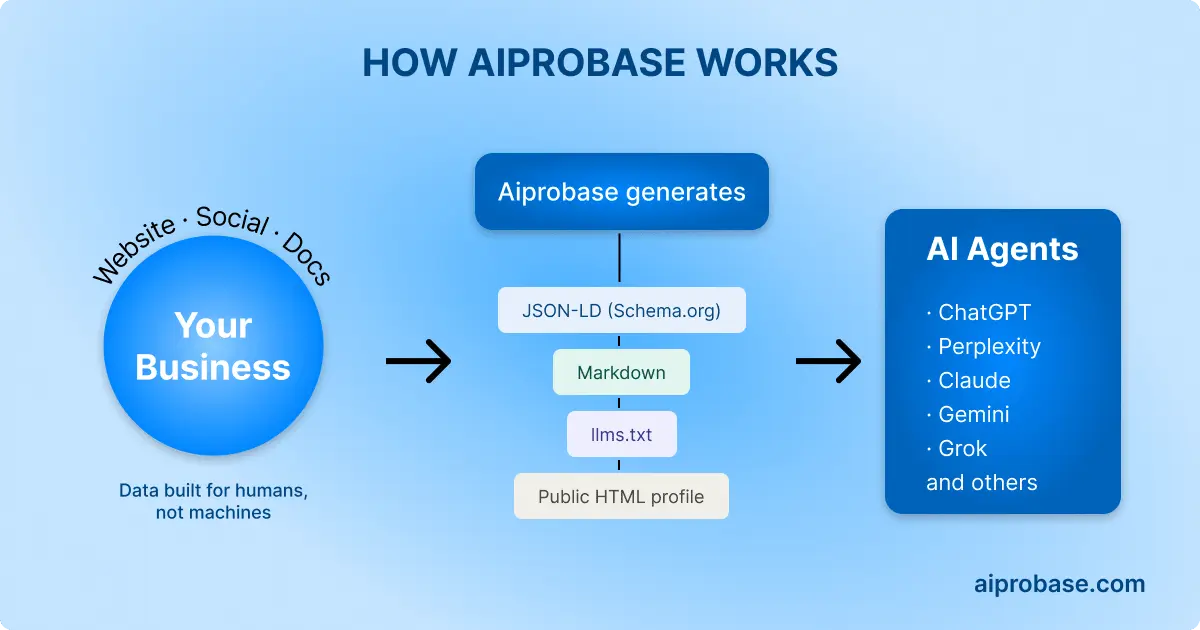
AI agents are getting good at finding businesses. The problem is what happens next: the agent has to work out what your business actually is, and it does that by piecing together whatever it can find about you. Your site, your reviews, your listings, a cached page from two years ago. Most of it written for people, some of it out of date, some of it about a different company with a similar name. The agent makes its best guess. Sometimes the guess is wrong.
That is the real gap, and it is not a reading problem. Modern AI reads prose perfectly well. It is an ambiguity problem. When the only signals are polished marketing copy and scattered third-party mentions, the agent has to infer what you do, who you serve, and what you charge. Inference is where businesses get mismatched, conflated, or quietly skipped.
A company needs a design studio specialising in Webflow. AI returns studios that work with WordPress.
A printing house needs maintenance for industrial equipment. AI delivers companies that service office printers.
A manufacturer needs a contractor to design and install solar panels on a 400 sqm commercial roof, full project documentation included. AI returns residential installers who don't do engineering work.
None of these are failures of reading. The right companies exist and their pages are perfectly legible. They are failures of disambiguation: nothing told the agent, authoritatively, which company fits. The agent inferred from soft signals and chose wrong.
Aiprobase creates a structured profile for your business or practice, optimised for how AI agents resolve entities. The underlying principle is Generative Engine Optimization: giving AI systems data they can read and act on without having to guess.
The difference between an ordinary web page and a structured profile isn't presentation. It's precision. A page says "We're a modern web agency with 10 years of experience." A profile states: specialisation, Webflow design and development; services, custom animations, CMS integration, responsive design; track record, 30+ Webflow projects completed. For a human reader the first version is fine. For an agent deciding whether you fit a specific request, the second leaves nothing to interpret.
There's a second reason this matters, and it's worth being precise about. Nobody has settled on one format. Some systems lean on JSON-LD and Schema.org. Some read Markdown more reliably than raw HTML. Some propose llms.txt; plenty ignore it. The standards are still being argued over by the companies building these tools. So Aiprobase publishes your profile in all of them at once, and lets each system take what it uses. You don't have to bet on the winner. And structured formats share one property that works in your favour: they are cleaner for a machine to parse than prose, which means less room for a system to misread you.
You fill out your profile once: services, location, expertise, pricing, working hours. Aiprobase converts that into the formats AI systems use to understand businesses, JSON-LD with Schema.org markup, Markdown, HTML, and llms.txt.
Your profile is published at aiprobase.com/p/yourname, open to search engines and AI crawlers, and available to download so you can embed the structured data directly on your own site.
Three things happen when you create a profile. Your business enters an open, crawlable directory built for AI agents to discover, not a walled garden. You get a dedicated profile page that works for human visitors and machines alike. And you get a structured JSON-LD file to host on your own domain, so when an agent visits your website it finds the structured layer underneath the content.
Aiprobase doesn't replace your website. It adds the structured layer your website doesn't have. The content that looks good to visitors stays exactly as it is.
McKinsey estimates AI agents could mediate $3–5 trillion of global consumer commerce by 2030. The implication for businesses is direct. As agents start to mediate discovery and purchases, the version of you they work from matters more, not less.
This isn't a future scenario. Agents are already assembling answers about businesses today. The ones they represent accurately tend to be the ones that gave them a clean, consistent set of facts. The ones they misread or skip tend to be the ones that left it to inference across scattered sources.
The question was never whether AI can read your website. It can. The question is whether the picture it builds of you is the one you'd actually stand behind, and whether you get a say in it. If you've relied on organic search for that visibility, the picture has changed.
arXiv / KDD 2024:
GEO: Generative Engine Optimization
Bain & Company (February 2025):
Goodbye Clicks, Hello AI: Zero-Click Search Redefines Marketing